
JAMB Chemistry: Nuclear Chemistry
Hello, JAMB Chemistry champions! We’re nearing the end of the core topics with Nuclear Chemistry—a fascinating yet straightforward section in the syllabus. It focuses on radioactivity, nuclear reactions, and their applications. Expect questions on distinguishing reaction types, radiation properties, half-life calculations, balancing equations, and real-world uses.
This topic ties into atomic structure (from the previous lesson) and emphasizes the nucleus’s role in energy changes. Let’s break it down comprehensively!
Table of Contents
Ordinary Chemical Reactions vs. Nuclear Reactions
- Chemical Reactions: Involve electron rearrangements in the outer shells. Atoms of elements remain the same; only bonding changes. Energy changes are small (kJ/mol), and mass is conserved perfectly.
- Nuclear Reactions: Involve changes in the nucleus (protons/neutrons). Elements transmute into others. Energy changes are huge (millions of times larger), and mass is slightly converted to energy (E = mc²).
JAMB tip: Chemical reactions can’t change one element into another; nuclear reactions can (e.g., U to Pb).
Radioactivity: Types and Properties of Radiations
Radioactivity is the spontaneous emission of radiation from unstable nuclei to achieve stability.
Main types:
- Alpha (α) particles: Helium nuclei (²He). Charge +2, mass ~4u. Low penetration (stopped by paper/skin), highly ionizing, deflected by magnetic/electric fields toward negative plate.
- Beta (β) particles: High-energy electrons (β⁻) or positrons (β⁺). Charge -1/+1, negligible mass. Medium penetration (stopped by aluminum foil), less ionizing than alpha, deflected toward opposite charge.
- Gamma (γ) rays: High-energy electromagnetic waves (photons). No charge/mass. High penetration (stopped by thick lead/concrete), least ionizing, no deflection.
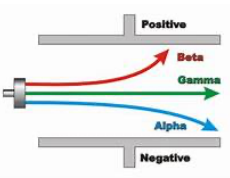

Properties summary:
| Radiation | Symbol | Nature | Charge | Mass | Penetration | Ionizing Power | Deflection in Field |
|---|---|---|---|---|---|---|---|
| Alpha | α | He nucleus | +2 | 4u | Low | High | Toward -ve plate |
| Beta | β | Electron/Positron | ±1 | ~0 | Medium | Medium | Toward opposite |
| Gamma | γ | EM wave | 0 | 0 | High | Low | None |
JAMB: Compare penetration and deflection—alpha bends most, gamma none.
Natural vs. Artificial Radioactivity
- Natural Radioactivity: Occurs spontaneously in unstable heavy elements (e.g., uranium, thorium, radium). Discovered by Becquerel (1896) and studied by Marie and Pierre Curie.
- Artificial Radioactivity: Induced by bombarding stable nuclei with particles (e.g., neutrons, protons). Most radioactive isotopes today are artificial (e.g., in reactors).
JAMB: Natural = spontaneous; artificial = human-induced.
Nuclear Reactions and Simple Equations
Nuclear reactions involve nucleus changes, often releasing energy.
Key types:
- Alpha Decay: Emission of α particle. Example: ²³⁸₉₂U → ²³⁴₉₀Th + ⁴₂He
- Beta Decay: Neutron → proton + electron (β⁻) or vice versa (β⁺). Example: ¹⁴₆C → ¹⁴₇N + e⁻ + ν (antineutrino, often omitted)
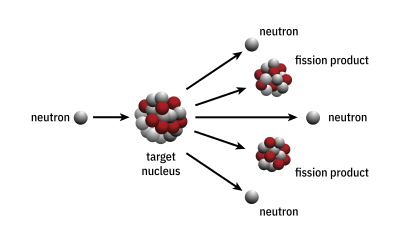
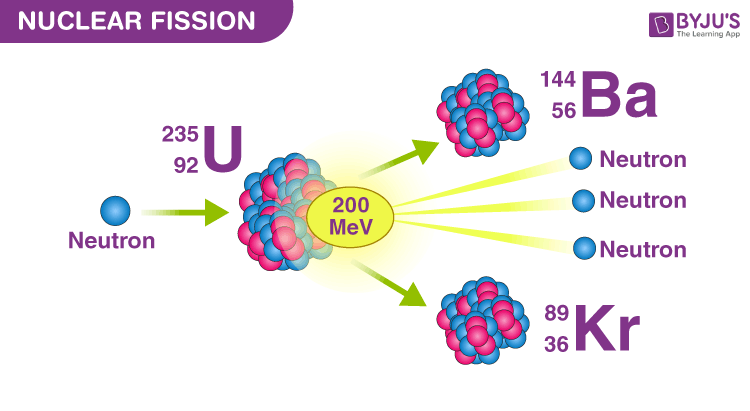
- Nuclear Fission: Heavy nucleus splits into two lighter ones + neutrons + energy. Example: ²³⁵₉₂U + ¹₀n → ¹⁴¹₅₆Ba + ⁹₂₃₆Kr + 3¹₀n + energy
- Nuclear Fusion: Light nuclei combine to form heavier one + energy. Example: ²₁H + ³₁H → ⁴₂He + ¹₀n + energy

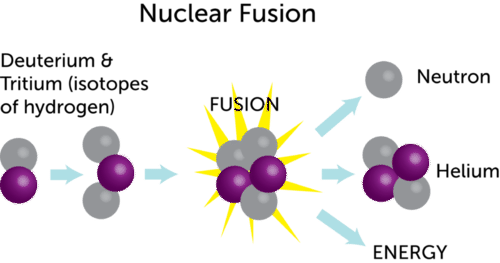
Balancing equations: Total mass number (A) and atomic number (Z) must balance on both sides.
Half-Life Calculations
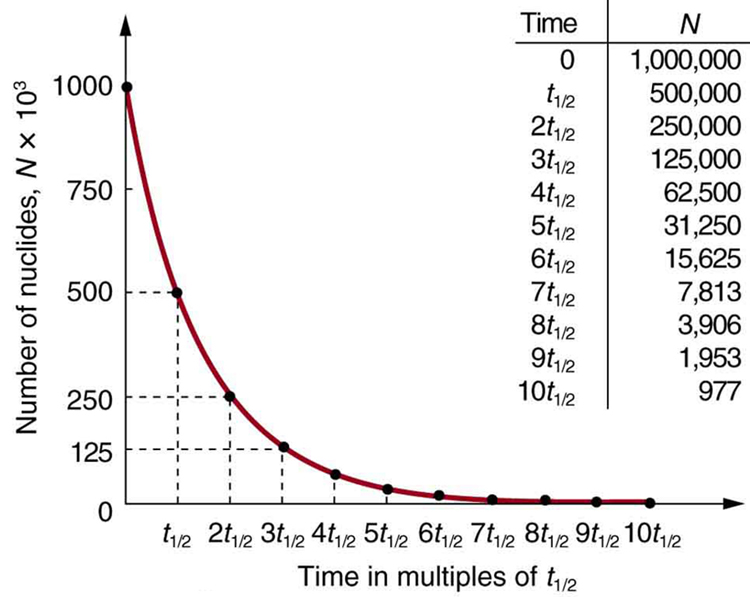
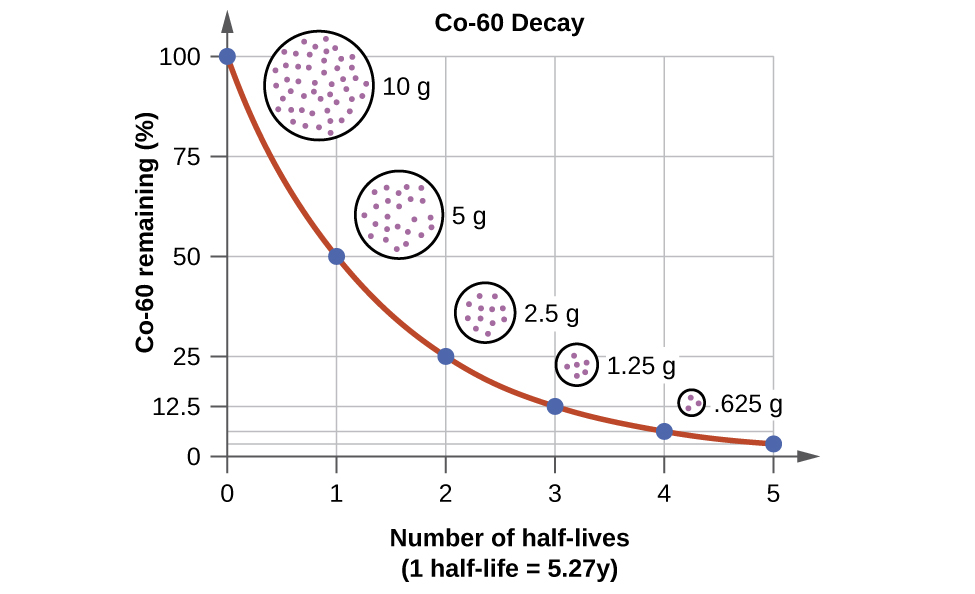
Half-life (t½): Time for half the radioactive atoms to decay.
Formula: N = N₀ (½)^(t/t½) Or, number of half-lives = t / t½ Fraction remaining = (½)^n where n = number of half-lives.
Example: If t½ = 5 days, and initial mass = 80 g, after 15 days (3 half-lives): Remaining = 80 × (½)³ = 80 × 1/8 = 10 g.
JAMB: Simple problems—calculate remaining mass, time for decay, or half-life from data.
Applications of Radioactivity
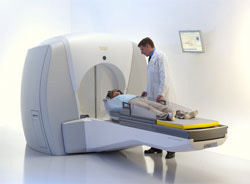
- Medical: Radiotherapy (Co-60 gamma for cancer), diagnostic imaging (Tc-99m scans, PET with F-18), tracers.
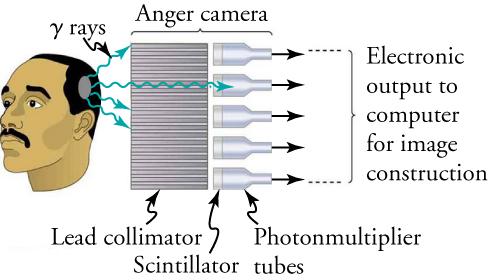
- Industry: Thickness gauges, smoke detectors (Am-241), sterilization.
- Archaeology/Geology: Carbon-14 dating (t½ = 5730 years) for organic materials up to ~50,000 years.

Radiocarbon Dating – an overview | ScienceDirect Topics
- Energy: Nuclear power plants (fission reactors).
- Other: Tracers in research, food irradiation.
JAMB Success Tips
- Memorize radiation properties table—easy marks!
- Practice balancing equations and half-life problems.
- Know: Fission = splitting heavy nuclei (power plants); Fusion = combining light nuclei (stars, future energy).
- Applications: Always link to specific isotopes (e.g., C-14 for dating).
You’ve covered a huge chunk of the syllabus now! Practice past JAMB questions on this topic—they’re often calculation-based. Questions or next topic? Let me know in the comments. You’re unstoppable!