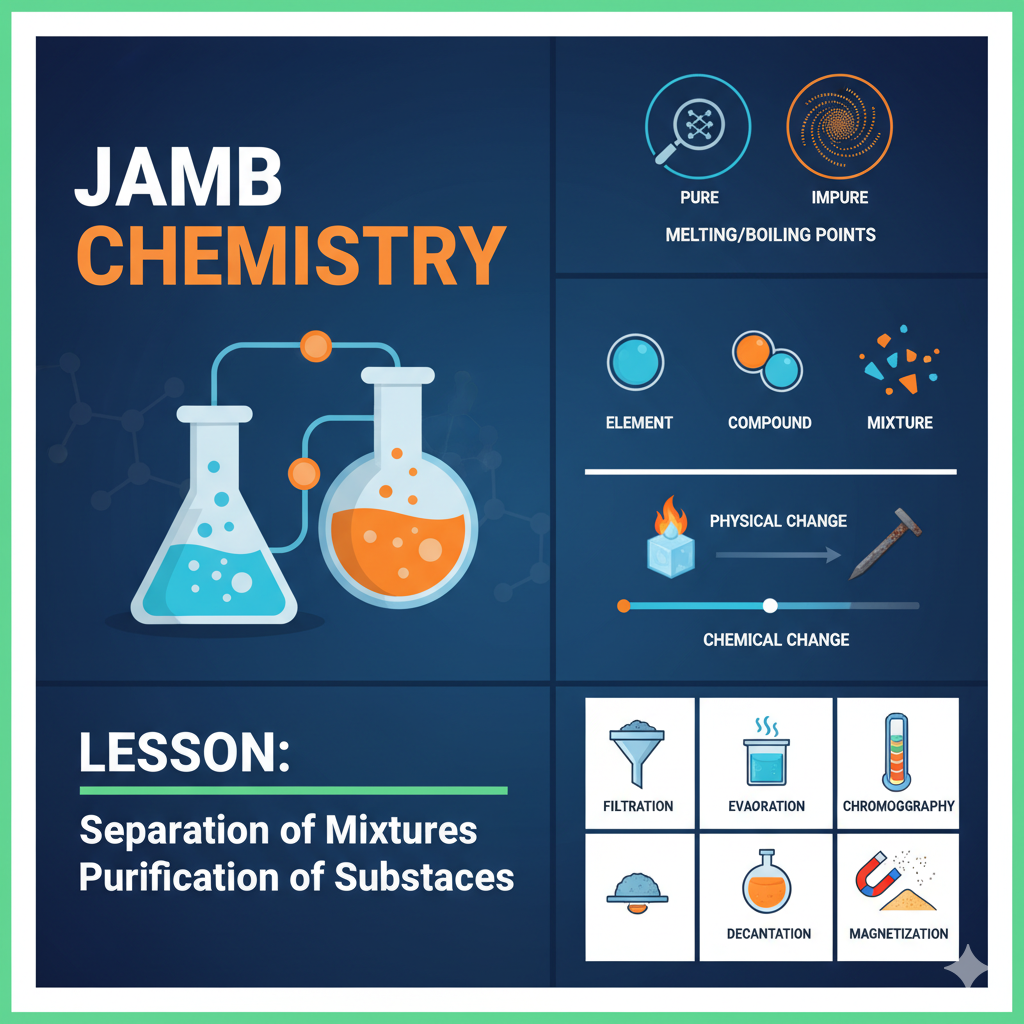
JAMB Chemistry Lesson: Separation of Mixtures & Purification of Substances
Hey there, aspiring chemists! If you’re preparing for the Joint Admissions and Matriculation Board (JAMB) exam in Nigeria, the topic of Separation of Mixtures and Purification of Chemical Substances is a cornerstone of the Chemistry syllabus. This section tests your understanding of fundamental concepts that form the basis for more advanced topics. In this blog post, we’ll break it down comprehensively, covering pure and impure substances, boiling and melting points, elements, compounds, mixtures, chemical and physical changes, and various separation techniques. We’ll align with the JAMB objectives, so you can distinguish key ideas, apply criteria for purity, and even see how these principles play out in everyday life. Let’s dive in!
Pure and Impure Substances
In chemistry, a pure substance consists of only one type of particle, like a single element or compound, with no contaminants. It has uniform properties throughout and a fixed composition. On the other hand, an impure substance contains two or more substances mixed together, leading to variable properties.
To distinguish between them, remember that pure substances have sharp, definite melting and boiling points, while impure ones melt or boil over a range of temperatures due to the presence of impurities that disrupt the structure.
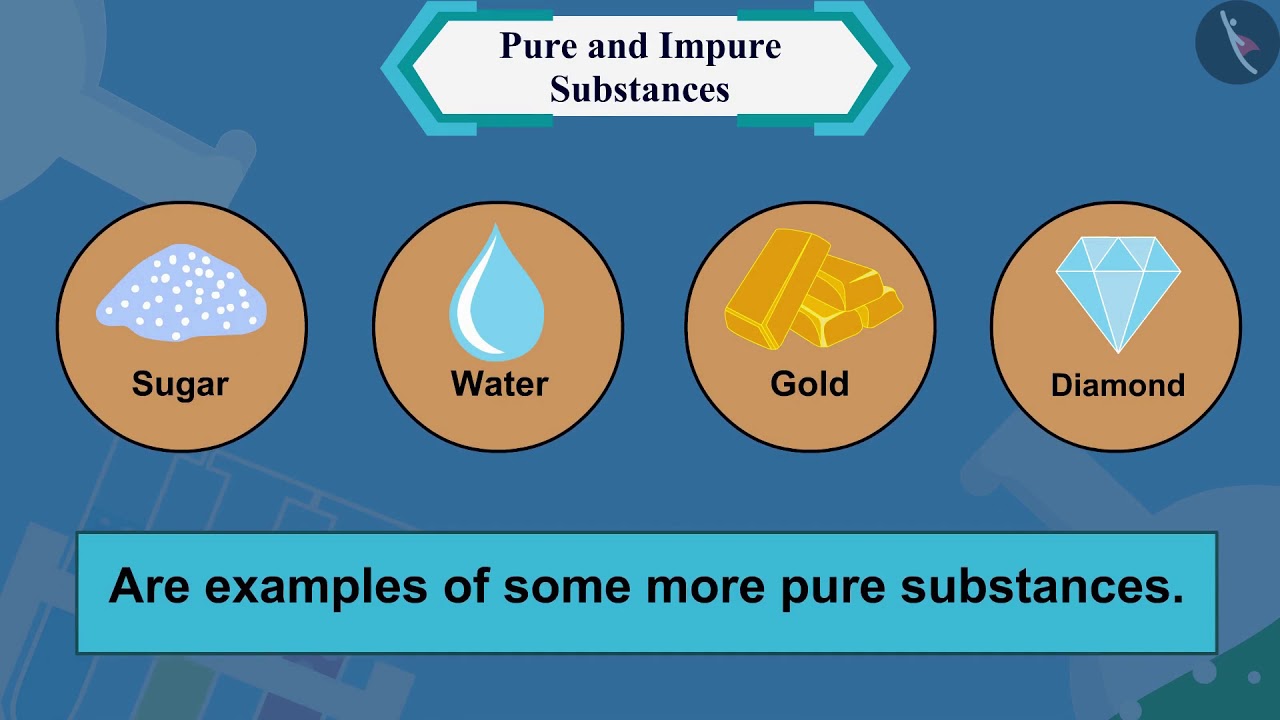
For JAMB, you should be able to identify purity based on these traits. For example, distilled water is pure because it’s free from salts and minerals, whereas tap water is impure.
Boiling and Melting Points as Criteria for Purity
Boiling and melting points are key indicators of purity. A pure substance melts or boils at a specific temperature—think of ice melting at exactly 0°C or water boiling at 100°C under standard conditions. Impurities lower the melting point and raise the boiling point, causing the process to occur over a temperature range rather than at a fixed point.
This is because impurities interfere with the intermolecular forces in the substance. In lab settings, we use these points to test purity: if a sample melts sharply at the known value for a compound, it’s likely pure.
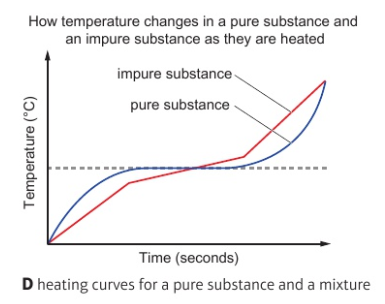
JAMB tip: Questions might ask you to interpret graphs showing temperature vs. time for heating or cooling curves. A plateau indicates a pure substance undergoing phase change, while a gradual slope points to impurity.
Elements, Compounds, and Mixtures
Let’s clarify these basics:
- Elements: The simplest form of matter, made of only one type of atom (e.g., oxygen, gold). They can’t be broken down further by chemical means and are listed on the periodic table.
- Compounds: Formed when two or more elements chemically combine in fixed ratios (e.g., water as H₂O, sodium chloride as NaCl). They have properties different from their elements and can be decomposed chemically.
- Mixtures: Combinations of two or more substances that are not chemically bonded, retaining their individual properties (e.g., air, saltwater). They can be separated physically and have variable compositions.
To distinguish: Elements and compounds are pure substances, while mixtures are impure unless homogeneous at the molecular level.
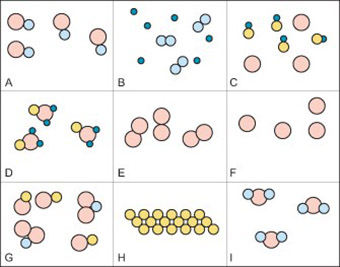
Picture from: OLCreate: TESSA_Eng Module 2: Secondary Science – chemistry
In JAMB, you might need to classify substances or explain why a mixture isn’t a compound (e.g., no fixed ratio, no new properties formed).
Chemical and Physical Changes
A physical change alters the form or appearance of a substance without changing its chemical composition (e.g., melting ice, dissolving sugar in water). It’s reversible, and no new substances form.
A chemical change involves a reaction where bonds break and reform, creating new substances with different properties (e.g., rusting iron, burning wood). It’s often irreversible and accompanied by energy changes, color shifts, or gas production.
Differentiate by checking for new substances: If you can recover the original by physical means, it’s physical; if not, it’s chemical.

Physical Chemical Changes Matter Infographic Diagram Stock Vector …
JAMB objective: Recognize examples like evaporation (physical) vs. combustion (chemical).
Separation Processes
Separation techniques exploit differences in physical properties of mixture components, such as solubility, boiling points, magnetism, or density. Here’s a breakdown of each method mentioned in the syllabus, including principles and everyday applications.
Evaporation
This separates a soluble solid from a liquid by heating the mixture to vaporize the liquid, leaving the solid behind. Principle: Difference in volatility (liquid evaporates, solid doesn’t).
Example: Recovering salt from seawater. In daily life: Drying clothes or concentrating syrup.
Simple Distillation
Used for separating liquids with different boiling points or a liquid from non-volatile solids. The mixture is heated; the lower-boiling component vaporizes first, condenses in a cooler, and is collected.
Principle: Boiling point differences (at least 25-30°C apart).

shutterstock.com
Illustration Educational Diagram Chart Showing Physics Stock …
Application: Purifying water from impurities or separating alcohol from water.
Fractional Distillation
Similar to simple distillation but for liquids with close boiling points. A fractionating column allows repeated vaporization-condensation, separating based on volatility gradients.
Principle: Gradual separation in the column due to boiling point differences.

chem.rochester.edu
Purification: Fractional Distillation
Everyday: Refining petroleum into fractions like gasoline and kerosene.
Sublimation
Separates substances that sublime (turn from solid to gas without melting) from non-sublimable ones. Heat the mixture; the sublimable component vaporizes and condenses elsewhere.
Principle: Sublimation property (e.g., iodine or naphthalene).

shutterstock.com
Diagram Sublimation Ammonium Chloride Lab Chemistry Stock Vector …
Application: Purifying iodine from impurities.
Filtration
Separates insoluble solids from liquids or gases using a porous barrier (filter paper). The liquid (filtrate) passes through; solids (residue) are trapped.
Principle: Particle size difference.
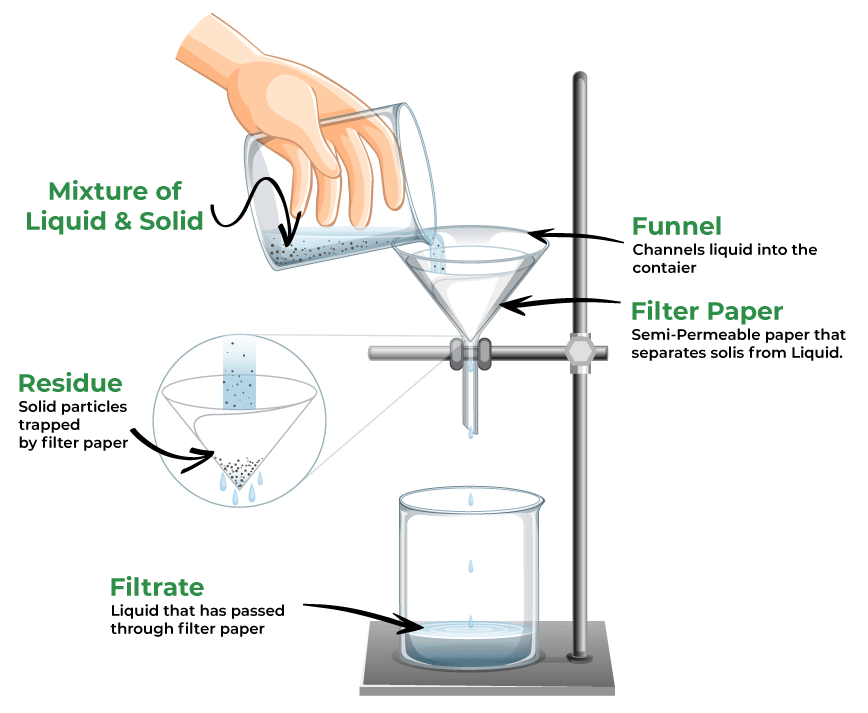
geeksforgeeks.org
Filtration: Definition, Process, Diagram and Examples – GeeksforGeeks
In life: Coffee filters or water purification systems.
Crystallization
Purifies solids by dissolving in a hot solvent, then cooling to form crystals of the pure substance, leaving impurities in solution.
Principle: Solubility decreases with temperature.
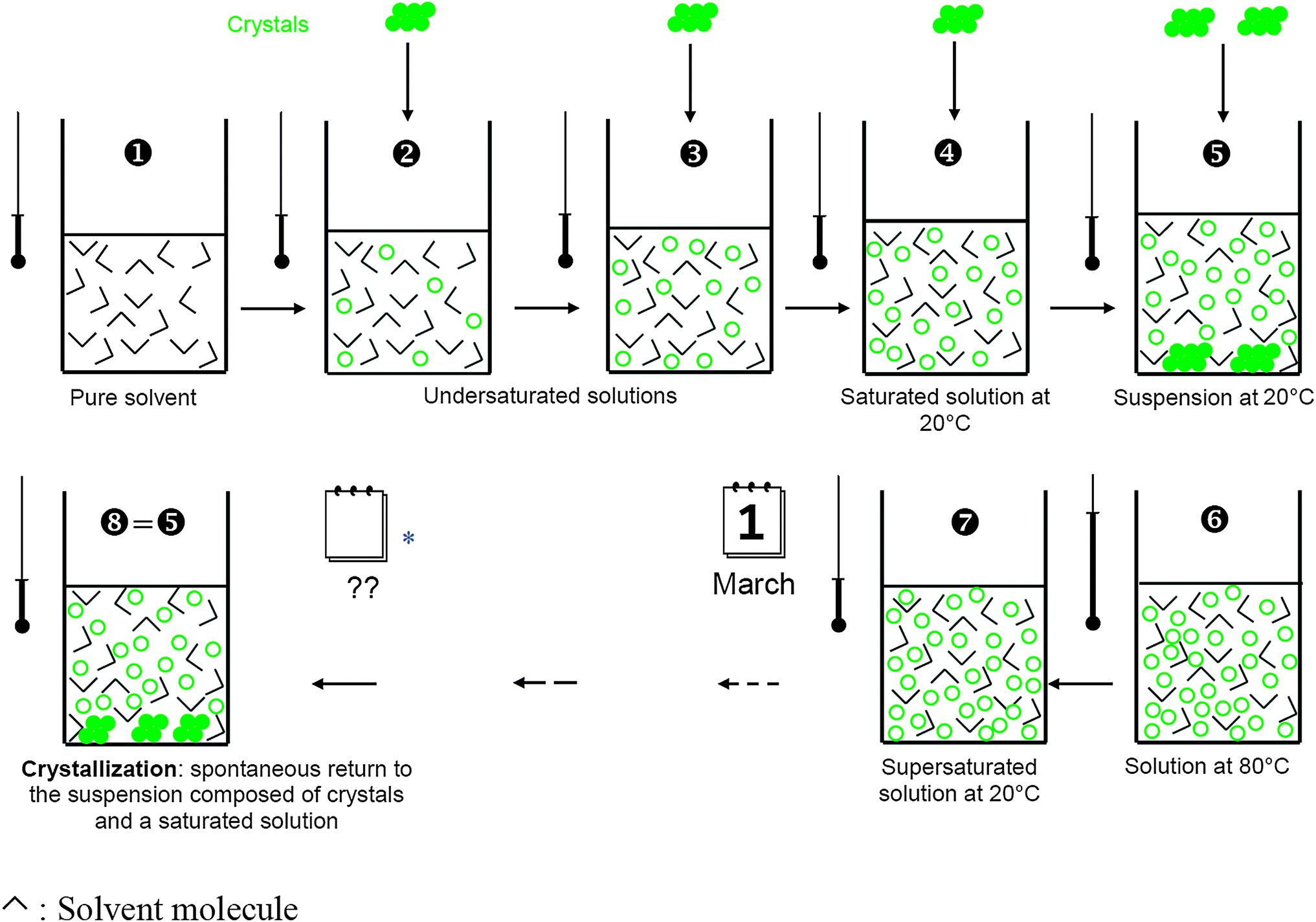
pubs.rsc.org
Crystallization of molecular systems from solution: phase diagrams …
Simple crystallization for single-step; fractional for separating similar solubilities by controlled cooling. Example: Purifying sugar.
Paper and Column Chromatography
Both separate mixtures based on differential adsorption and solubility on a stationary phase.
- Paper Chromatography: Uses filter paper as stationary phase; solvent moves up, carrying components at different rates (Rf values).
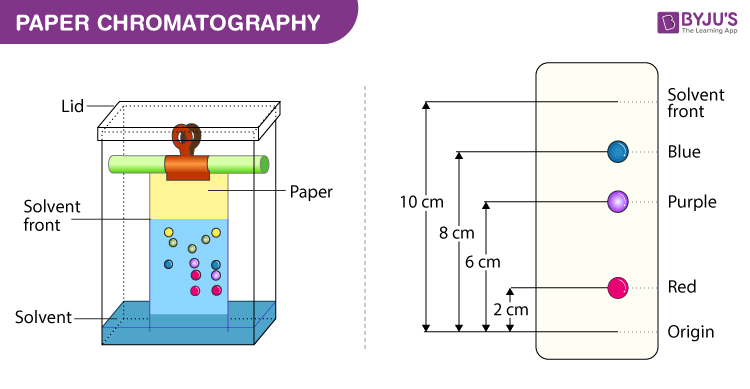
Paper chromatography | BYJU’S
Principle: Affinity for mobile (solvent) vs. stationary phase. Application: Separating ink pigments.
- Column Chromatography: Similar but uses a column packed with adsorbent (e.g., silica gel); eluent washes components out sequentially.
Application: Drug purification in labs.
Magnetization
Separates magnetic materials (e.g., iron) from non-magnetic ones using a magnet.
Principle: Magnetic properties.
Example: Recycling scrap metal.
Decantation
Separates immiscible liquids or solids from liquids by carefully pouring off the top layer.
Principle: Density differences (denser settles at bottom).
Application: Separating oil from water in cooking.
For JAMB: Identify properties of components (e.g., volatility for distillation) and choose the right method for a mixture. Apply in life: Water treatment (filtration, distillation), cooking (decantation), or recycling (magnetization).
Wrapping It Up: Tips for JAMB Success
You’ve now covered the essentials! To excel, practice past questions: Distinguish pure/impure, interpret phase diagrams, classify changes, and select separation methods. Remember, these processes are physical, preserving component identities.
In everyday life, think of brewing tea (filtration), distilling palm wine, or sorting recyclables. Stay curious—chemistry is everywhere!